Mutual Fund Lien: A Detailed Guide 2024
Key Takeaways: You can get a loan against mutual fund units by marking a lien. A lien is marked by the lender on your mutual fund units, not the amount.
50Fin
June 6, 2025
4 min read

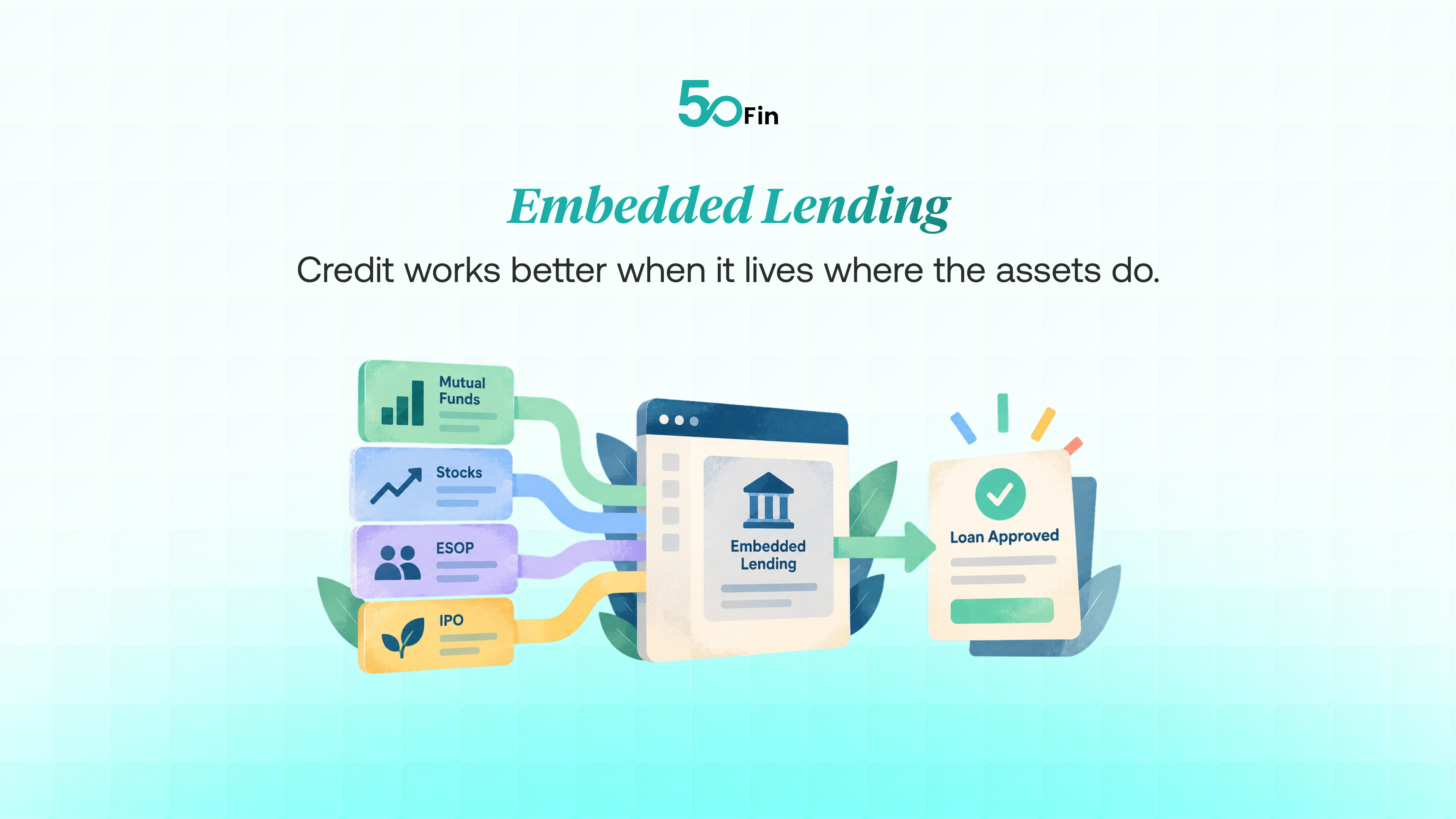
Embedded lending against securities gives eligible investors another way to meet a funding need while retaining their investments. For a wealth platform, designers should focus the product on the customer's ability to understand and manage the borrowing decision, including its costs, repayment requirements, and collateral risks. Assets retained on the platform are an incomplete measure of success.
A customer's need for cash can arise independently of their investment view. Someone investing for a long-term objective may face an expense before an expected receipt arrives. Selling investments is one response. Depending on eligibility and circumstances, borrowing against them may be another.
Loans against mutual funds demonstrate the basic mechanism: the customer pledges eligible units as collateral to borrow without redeeming those units initially. 50Fin's product FAQs describe this structure. The investment remains exposed to market movements, and the loan creates obligations that do not disappear if returns disappoint.
For platforms, this places product design at the intersection of investing, credit and ongoing service. The application journey is only one part of that relationship.
The presence of a portfolio establishes neither the need for a loan nor the ability to repay it. A useful journey helps the customer consider the amount required, the expected duration and the source of repayment.
Take two hypothetical investors with similar eligible portfolios. One expects a known payment and needs a temporary bridge. The other has a recurring gap between income and spending. Similar collateral can support very different borrowing decisions.
The first situation still involves risk because the expected payment may be delayed or not arrive. In the second, a loan can postpone a cash-flow problem while adding a continuing expense. Neither conclusion can be reached from portfolio size alone.
A platform should therefore evaluate where and how it introduces credit. The context can help customers consider the decision, while the lender applies its eligibility and credit requirements. Product design should avoid suggesting that an available borrowing limit is a financial objective in itself.
This is important when the customer is already considering redemption. Present the borrowing option with enough information to allow meaningful comparison with selling, using available cash, or reconsidering the expense.
Keeping an investment and taking a loan creates two ongoing positions. The customer remains exposed to the asset and also owes the borrowing cost. Expected investment performance is uncertain; a repayment obligation has specified terms.
That makes “stay invested” an incomplete explanation. It needs to sit beside the total cost of the facility, the repayment schedule or structure, and the consequences of a decline in eligible collateral value.
The customer should understand what could require additional collateral or repayment, where to find the applicable thresholds and terms, and how the lender communicates a required action. The exact process depends on the facility. A generic claim that borrowing preserves long-term returns would be misleading.
The comparison with redemption also needs care. Selling reduces the investment position and may have fund-specific or tax consequences. Borrowing preserves exposure but adds cost and collateral obligations. The appropriate choice depends on the customer's circumstances and the relevant terms; a platform should make those inputs accessible without implying a universal winner.
Clear explanations help the customer decide whether the product fits the need before starting an application that creates momentum towards borrowing.
A wealth platform has a commercial reason to care about retained assets. When an investor can meet a suitable temporary funding need without redeeming, the platform may continue to serve that investment relationship.
The incentive becomes problematic if every prevented redemption is treated as a successful outcome. A customer may be better served by selling part of a portfolio, particularly when the loan would create an unaffordable obligation or depend on uncertain future income.
A more balanced evaluation would consider what happens after borrowing. Do customers understand the terms? Can they find their lender and servicing contact? Are requests and complaints resolved clearly? Do customers receive understandable information when collateral conditions change?
These are proposed product questions, rather than claims about measured outcomes at any institution. They broaden the definition of a successful journey beyond initial conversion and assets retained.
The platform earns a more durable relationship when it gives the customer room to make a suitable choice, including a choice that reduces the platform's assets today.
An embedded journey can involve the wealth platform, a lender and technology or service providers. The customer needs a clear understanding of whom they are borrowing from and where to go when something needs attention.
That clarity should extend to routine events. Where does the customer view the recognised outstanding balance? How do they make a repayment? Where can they request a collateral release, and how will they know when it has completed?
50Fin's embedded LAS offering describes API and white-label routes for placing lending journeys within a partner experience. The chosen route still needs a defined servicing model between the participating organisations.
Consider a customer who has initiated repayment and wants their pledged units released. The platform's support team needs a reliable way to determine whether repayment is recognised, whether release is permitted and whether any instruction is still pending.
If those answers require several unowned handoffs, the customer's experience can deteriorate even when the initial application worked well. The integration plan should make the support path as concrete as the acquisition path.
There is a reasonable argument for keeping a first release narrow. A platform may begin with a defined customer group, a limited set of collateral types or a carefully specified journey. That can make responsibilities and exceptions easier to understand.
A narrow scope is useful only when its limits are clear to customers and support teams. Eligibility should reflect the actual facility, and the experience should explain why an asset or request is unavailable rather than leaving the customer to guess.
The launch review should include the normal path and several exceptions: an ineligible holding, an application that cannot proceed, a repayment awaiting confirmation and a release request requiring further assessment.
For each case, the participating teams should agree on the customer message, the source used to establish status, and the person responsible for resolution. These practical acceptance criteria allow teams to test them before broadening distribution.
A staged launch can then generate evidence about support demand and process reliability. Expanding on that evidence is more defensible than assuming that a working application proves the entire service is ready for every eligible customer.
Some wealth platforms may have good reasons to defer embedded lending. The relevant customer need may be limited; the servicing model may be unresolved; or the platform may lack the capacity to explain and support the product adequately.
Introducing a referral route can also be a legitimate choice if the roles and customer experience are clear. Deeper integration is not automatically better. It increases the importance of reliable information moving between the systems and teams involved.
The appropriate design should follow the problem the platform is trying to solve. A loan product with weak relevance and unclear support can divert attention that should focus on enhancing the core investment experience.
For platforms that proceed, a useful standard is to follow the customer from the original need through repayment and collateral release. At each stage, ask whether the customer understands the decision and can obtain a clear answer when something changes.
The opportunity in embedded lending is to remain useful when a customer's financial circumstances change. That value lasts only as long as the borrowing experience deserves the customer's trust.
Explore 50Fin's embedded LAS capabilities to discuss a journey and servicing model suited to your platform.