Why lending against mutual funds and stocks needs more than a digital application journey
A borrower opening a line of credit against investments may experience a remarkably short journey: fetch a portfolio, see eligible mutual-fund units and listed shares, complete KYC, pledge securities, sign the agreement and receive a sanctioned limit.
That experience matters. But it can create an origination illusion: because the front end is simple, the lending operation behind it must also be simple.
It is not. The real operating work begins when the collateral has been pledged and continues for as long as the facility remains open.
The borrower sees a short journey. The lender must keep the loan, mutual-fund units, listed shares, policy rules and external records in sync throughout the facility.
The collateral does not sit still
In a conventional secured loan, collateral is often treated as a value established during underwriting and revisited periodically. In lending against securities, the collateral is a moving portfolio.
Mutual-fund NAVs change. Listed-stock prices move during market hours. A security can remain pledged while its contribution to drawing power changes. An approved-security list can differ by lender, scheme or scrip. Haircuts, LTV limits, concentration rules and exposure rules determine how much of a portfolio is actually lendable.
So approval-day eligibility is only a snapshot. The lender needs to continuously see which units and shares are pledged, their applicable value, the outstanding exposure, available drawing power, and any shortfall that requires action.
Illustrative values only. The point is the changing relationship between portfolio value, eligible collateral, drawing power and outstanding exposure—not a claim about a customer or portfolio.
This changes the nature of the software problem. The system is not merely recording a loan against an asset. It is coordinating a relationship between a credit facility and a portfolio whose state and value can change independently.
A practical definition
A capital-markets Lending OS is the operating layer that keeps the facility coherent after disbursal: what is pledged, what the position is worth, what credit remains available, what controls permit and who is authorised to change the state. In 50Fin's architecture, the LOS and platforms handle the journey through disbursal and afterl; the Lending OS brings together collateral management, risk management, reporting, analytics, masters and role-governed operations used to run the book.
The word operating matters. A Lending OS is not simply another screen, workflow or database. Its job is to maintain a shared state: what the borrower owns, what is eligible, what has been pledged, what credit is available, what has changed and which action is allowed next.
For 50Fin, this category is grounded in concrete LAS workflows—not a generic claim about every kind of lending.
The pledged portfolio plays at least four roles simultaneously:
Asset: the mutual-fund units or shares owned by the borrower.
Risk input: their value and policy treatment affect LTV and drawing power.
Operating state: units or shares may be available, pledge-initiated, pledged, release-initiated, released, partially processed or failed.
Control boundary: actions may require validation, maker-checker approval, external confirmation and an audit trail.
That is why a lender cannot safely model the facility as “loan approved” plus “collateral attached.” It must understand the current state of both—and the relationship between them.
The real test is what happens after disbursal
Consider a borrower asking to unpledge some mutual-fund units or listed shares. A good digital interface can capture the request in seconds. But the operating decision depends on much more than the request itself.
The lender needs the current outstanding, the latest accepted collateral value, the relevant haircut and LTV rules, the residual portfolio after release, and any existing shortfall or concentration breach. The action may need a maker and checker. It must then travel through the appropriate mutual-fund or depository workflow and return as a full, partial or failed result. Finally, the internal position must be reconciled to the external record.
Illustrative workflow. Exact integrations, control steps and valuation frequency depend on the lender's operating model and should be confirmed before publication.
This is not a button click. It is a governed state transition.
The same is true of top-ups, drawdowns, repayments, shortfall resolution and collateral substitution. Every action changes one part of the system and may change what is permissible elsewhere.
The seven layers that must behave as one system
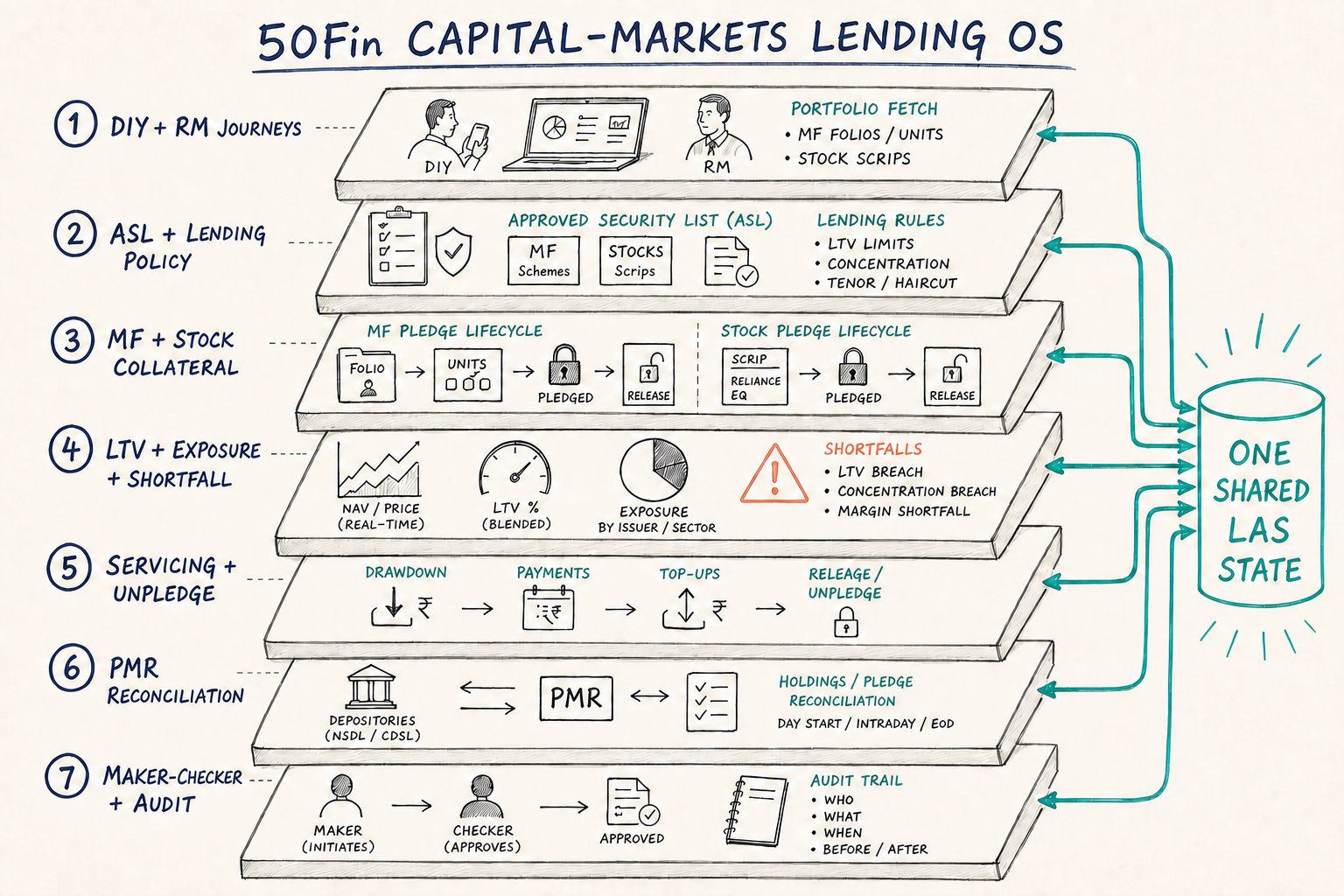
A functioning LAS operation brings together seven connected layers:
Origination and distribution: DIY and RM-assisted journeys, portfolio discovery, KYC, agreements and disbursal.
Policy: approved mutual-fund schemes and stock scrips, LTVs, haircuts, tenor, concentration and exposure rules.
Collateral: pledge and release lifecycles for mutual-fund units and listed shares, including partial and failed outcomes.
Risk: accepted NAV or price inputs, drawing power, issuer or sector exposure, and shortfall states.
Servicing: drawdowns, payments, top-ups, withdrawals and unpledge requests.
Reconciliation: comparison of internal positions with PMR, RTA and depository records at defined operating intervals.
Governance: maker-checker controls, role-based action rights and an audit trail of who changed what and when.
The architectural point is not that every lender needs one monolithic product. The LOS and Lending OS can sit together or alongside parts of an existing stack. What matters is that the layers share a coherent customer, loan, collateral and action state while the lender's CBS or LMS remains the book's system of record.
Why stitching together point solutions becomes difficult
A lender can assemble parts of the journey from an LOS, an LMS, a collateral system, risk spreadsheets, operations queues, RTA or depository integrations and internal reports. Each component can be competent at its own job.
The problem appears at the boundaries. Which system is authoritative when a pledge is partially completed? When should a failed transaction be retried? Does the risk view use the same accepted collateral position as servicing? Can an RM promise an unpledge before operations confirms that residual drawing power remains sufficient? Has the external record been reconciled to the internal one?
A Lending OS does not eliminate specialist systems. It coordinates them around a shared loan, collateral and action state so that a change in one layer is understood by the others.
That is the difference between digitising individual steps and operating the facility as a system.
What should a lender evaluate?
The strongest buying questions are therefore not limited to application completion rates or time to sanction. A lender should also ask:
Can the platform model mutual-fund units and listed shares through their full pledge and release lifecycles?
Can policy be configured by scheme, scrip, LTV, haircut, concentration and exposure rule?
How does the platform calculate and govern drawing power and shortfalls?
What happens when an external pledge or unpledge is partial, delayed or failed?
Which actions require maker-checker approval, and is the before-and-after state auditable?
How are internal positions reconciled with PMR, RTA and depository records?
Can DIY, RM, risk and operations users act on the same current state?
The dangerous exception is revealing: a platform can look excellent in a happy-path demo and still leave the lender dependent on spreadsheets and manual queues when the LAS journey breaks.
Where 50Fin fits
50Fin is a Lending OS with a SaaS operating layer for capital-markets lending, designed to work with a bank or NBFC's existing core environment. Its proposed product architecture separates the LOS—the system that takes multiple customer and sourcing journeys through disbursal—from the Lending OS that runs collateral, risk, reporting, configuration and control after disbursal.
Its relevance is clearest when expressed through the real objects and actions of LAS: mutual-fund folios and units, listed-stock holdings and scrips, approved-security lists, pledged and unpledged states, LTV and drawing power, exposure and shortfall monitoring, PMR reconciliation, and maker-checker-controlled operations.
It's more than any “digital lending platform.” It is a complex platform, painstakingly built, that helps keep things simple for both the borrowers and the lenders.
The category shift
The first generation of digital lending improved how a borrower applies. The next challenge in lending against securities is to improve how the facility behaves after approval—while the portfolio changes, transactions cross external rails, and operational exceptions accumulate.
That requires more than an attractive origination layer. It requires an operating layer built around the continuous relationship between the loan and the securities securing it.



%20vs%20Lump%20Sum.webp)

