How to operate a securities-backed loan after disbursal
50Fin
November 2, 2026
Lending is just the first piece. The real moment of truth comes when you have to see the loan through its lifecycle.
An effective Loan Against Securities operating model keeps the recognised loan balance, eligible collateral, lender policy and permitted customer actions consistent throughout the life of the facility. Lenders evaluating technology should test how those records change together, particularly when a repayment, valuation update or collateral request is still pending.
A digital application can make the beginning of a loan straightforward. The borrower takes the necessary steps, pledges eligible securities, and the lender provides the facility. That is an important achievement. Every subsequent request, however, depends on an account whose circumstances can change.
A fall in the value of pledged securities can reduce borrowing capacity. Once the system recognises a repayment, it can reduce exposure. A request to release collateral can change the assets supporting the loan. Each event affects the decisions that follow it.
This gives lenders a practical way to assess their operating model: choose a loan and follow its changing state through several ordinary events. The quality of the answers matters more than the number of screens in the demonstration.
Start with the relationship between debt and eligible collateral
The market value of a portfolio and the amount a lender is willing to advance against it are different quantities. Eligibility rules, permitted loan-to-value ratios and other applicable limits determine how much of that value supports borrowing.
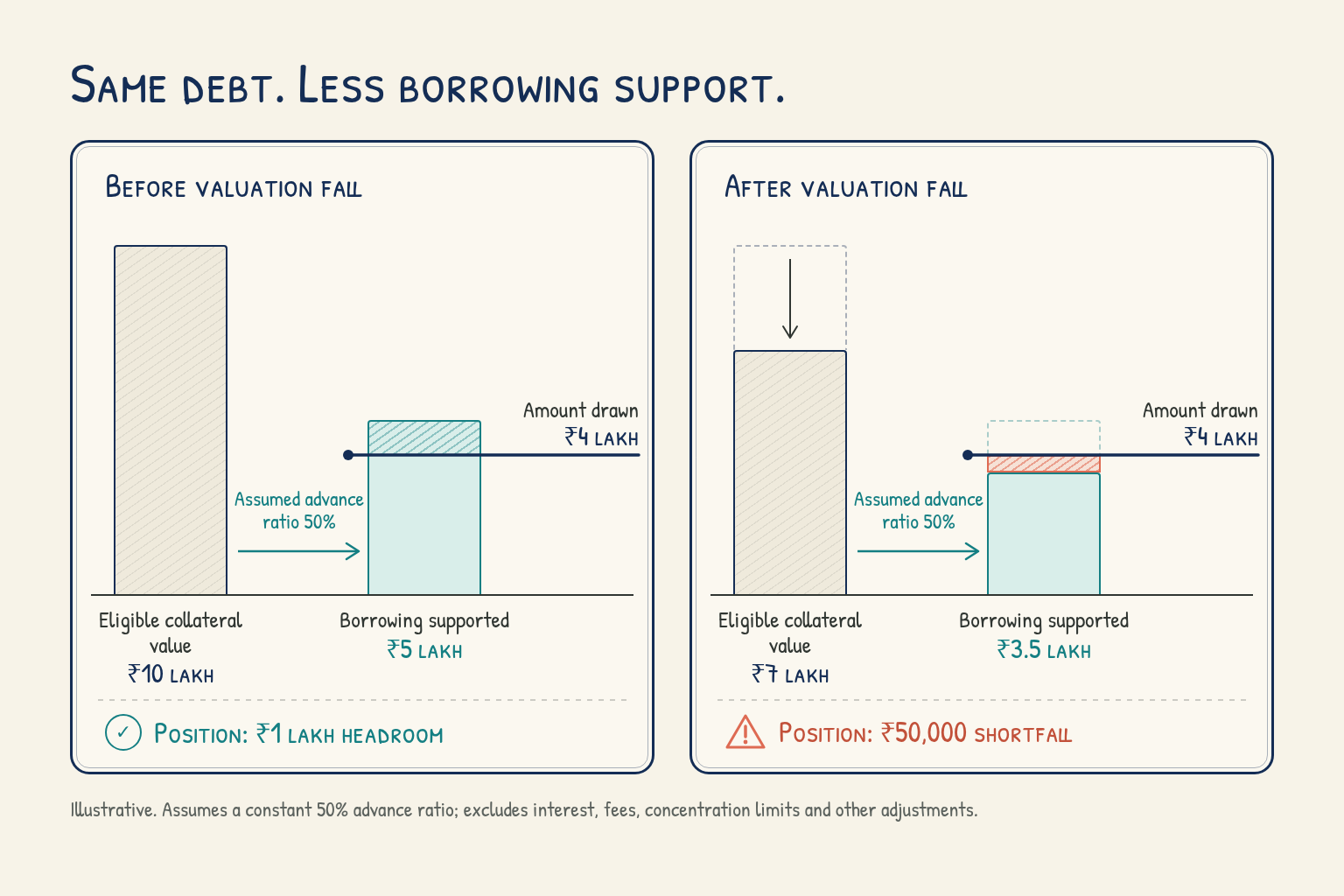
Consider a deliberately simplified example. Assume eligible pledged collateral is worth Rs 10 lakh, the permitted advance is 50% of that value, and the borrower has drawn Rs 4 lakh. Ignore interest, fees, concentration limits and other adjustments for this illustration.
On those assumptions, the collateral supports Rs 5 lakh of borrowing. If its value falls to Rs 7 lakh and the same advance ratio continues to apply, it is supported by Rs 3.5 lakh. The unchanged Rs 4 lakh draw now exceeds that amount by Rs 50,000.
The example is hypothetical, and 50% is an assumed ratio rather than a statement of any lender's terms. Its purpose is to show why an account can require action even though the borrower has taken no additional money.
Collateral values can change the account's position even when the amount drawn stays unchanged.
Actual calculations must use the lender's approved definitions and relevant inputs. Operations also needs to know how the result connects to restrictions, communications and available remedies. A number without that connection leaves the team to reconstruct the policy for each case.
Define what happens after a shortfall is identified
A useful shortfall process records the amount, its age, the responsible owner and the next permitted action. It also distinguishes between a proposed remedy and a confirmed change to the account.
For example, a borrower may choose to add eligible collateral. That choice does not establish that the pledge has been completed. Alternatively, a borrower may initiate repayment. The operating record still needs to establish when the payment has been recognised for the relevant decision.
Until then, the process needs an honest intermediate state. Operations should be able to see the action in progress, identify the dependency and understand what the customer can do while waiting. Customer communication should reflect the same position.
The treatment of unresolved shortfalls, including any escalation or liquidation, depends on the applicable agreement and lender policy. A generic workflow diagram cannot supply those terms. The implementation must translate them into a process with clear responsibilities and records.
50Fin's Risk Management System packs collateral revaluation, shortfall management and configurable exposure controls. Those capability families are useful starting points for a demonstration; the lender should then test the exact sequence required by its operating model.
Treat collateral release as a fresh decision
Releasing securities changes the assets available to support the outstanding loan. The assessment therefore needs to consider the account after the proposed release.
Return to the simplified example. Before the valuation fall, a borrower with Rs 10 lakh of collateral and Rs 4 lakh drawn requests the release of securities worth Rs 3 lakh. Under the assumed 50% advance ratio, the remaining Rs 7 lakh would support only Rs 3.5 lakh of borrowing. The proposed release would remove more borrowing support than the account can spare.
This is why a portfolio's total value is an insufficient guide to the release decision. The particular securities, their eligibility and the applicable limits matter. So does the balance that the lender recognises at the time of assessment.
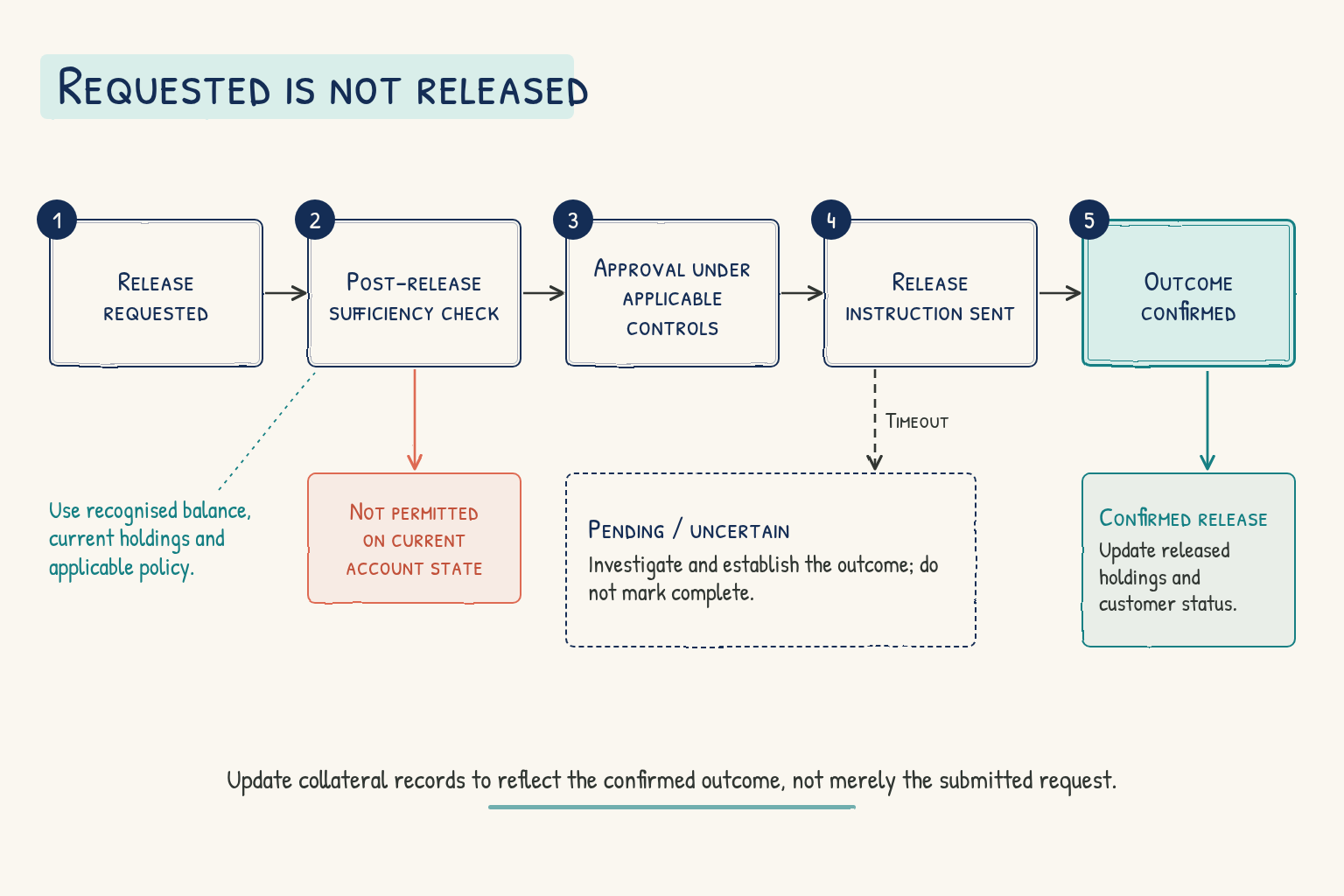
The workflow should preserve the distinction between a request, an approval, an instruction sent to the relevant external system and a confirmed outcome. A customer-facing interface can explain these states simply while the operating record retains the detail.
50Fin's Collateral Management System also comes with digital unpledging and maker-checker tools. A meaningful evaluation should follow an ordinary release and a restricted release through the controls that apply to each.
Make uncertainty visible when systems disagree
Suppose the lending application shows a repayment as initiated while the authoritative loan record still shows the earlier balance. Both screens can accurately describe different stages of the same event.
The difficulty begins when a dependent action assumes that the stages are interchangeable. A release decision might use a lower exposure before that exposure is confirmed, or support might tell the customer a process has finished while another system still has work to do.
An implementation should define which source is authoritative for each fact and which confirmation is required before the next action. It should also specify the response to late, missing or conflicting information.
Reconciliation then has an operational purpose. It identifies a discrepancy, gives someone responsibility for investigating it, and records how it was resolved. Simply displaying two different values does not complete that task.
The strongest demonstrations include uncertainty. Ask what happens if a release instruction times out, or a confirmation arrives after a retry. The team should explain how it determines the outcome of the original request before assuming a new instruction is needed.
Update collateral records to reflect the confirmed outcome, not merely the submitted request.
Keep manual work where it earns its place
A small, stable book may be operated responsibly through controlled manual processes. Experienced teams can apply judgment to unusual cases, particularly where a lender deliberately requires human review.
The decision to automate should consider the repeatability of the work, its time sensitivity and the consequences of error. An infrequent, complex exception may deserve detailed review. A routine calculation applied across many accounts may benefit from consistent system execution and clear handling of failures.
The relevant capacity test includes difficult periods. A market movement can affect several accounts at once, creating correlated operational demand. Average daily case volumes alone will not show whether the team can manage that workload.
Lenders can assess the position by measuring outstanding cases and their age, time to confirmed resolution by action type, and the proportion that needs repeated manual intervention. These are proposed management measures, not claims about a particular platform's results. They help reveal where the operating design needs attention.
Test the operating model through one complete account journey
Before accepting a system, take one representative facility through a valuation change, a shortfall, a remedy and a subsequent collateral release. Include at least one delayed confirmation.
At each step, establish which record changed, which actions became available or restricted, who owns any pending work, and what the customer was told. Then check that the final account and collateral records match the confirmed outcome.
This exercise connects business policy to implementation without requiring every stakeholder to inspect the underlying code. Credit can assess the decisions, operations can inspect the handoffs, and technology can test the dependencies.
The result should be a facility whose current position can be explained and whose next action can be justified. That is the practical standard for operating a securities-backed loan after disbursement.